Loving Martha: On Memory and Mother’s Day

Martha
A favorite picture of Mother, taken on her last trip to the Chautauqua Institution, where we often vacationed together.

This is my family’s second Mother’s Day since Mother’s diagnosis of dementia. And it’s the first one that caused me to hesitate and wonder, “Do I send her a card?” Whereupon I immediately felt sad, and guilty, and utterly unsure of myself. Who questions whether to send their mother, a much beloved woman, a card?

Last year we were all on auto pilot, I guess, trying to keep everything as normal as possible. This year I cannot deny how much things have changed for us. I wasn’t concerned that Mother might forget reading the card minutes after she opened it. I was worried that she might have forgotten me.

It’s one of the things that scares my sisters and me most, that our mother might not know us one day. “Don’t borrow trouble,” friends advise, and I try not to, even though I’ve spent much of my life doing just that, long before things went wonky with Mother. (I won’t bore you with all the things I’ve worried about that never came to pass. You can thank me later.)  It may be that Mother will recognize us until the day she dies. But the very real possibility that she won’t pops up now and again.

I’m the youngest of three daughters. No sons. My sisters are ten and seven years my senior. As a teenager, it didn’t occur to me that I might have been a surprise. Occasionally I noticed that my friends’ parents looked younger than mine—my parents were forty when they had me—but I didn’t resent it or spend too much time trying to figure out what it might mean for my future. I liked hanging out with adults, and I grew up wanting to be older. I wasn’t scared of middle age; I longed for it. In so doing, I suspect I missed out on some youthful—and perhaps necessary—experiences. But it suited me, this way of being brought up.

“We treated you like you were thirty from the time you were six years old,” my father would joke.

On a ferry from Wood’s Hole to Martha’s Vineyard some twenty-five years ago, I asked my mother if I had been a mistake. I don’t know what made me pose the question then, but it was one of those moments of deep connection in which nothing seems off limits. We were two women on a road trip from Washington, DC, where I was living at the time, to New England. We’d toured the Rhode Island School of Design in Providence, shopped for antiques in Connecticut, and were now bound for the Black Dog Bakery.

“Of course not,” she said, facing into the wind. Then there passed one beat of silence, two. If I were telling you this story in person I would snap my fingers twice for effect.

“But if you were,” she added, turning to look me straight on, “you were the best mistake I ever made.”

I did send the card, the day before I read this, written by a woman I worked with in another lifetime, Paula Spencer Scott. She hired me for my first gig out of graduate school, working for Whittle Communications, which I count as one of the highlights of my career. Now she’s an accomplished writer and a contributing editor over at Caring.com, and she’s had family members with dementia and Alzheimer’s. When suggesting things to do for your loved one with memory issues, Scott advises, among other things, to “Keep giving cards. She might not remember opening it five minutes later, but so what? What matters is delighting her in the moment.” (www.huffingtonpost.com)

I’m learning a lot about that these days, being “in the moment.” Spending time with Mother brings it all to the here and now. When you’re holding your ninety-two-year-old mother’s hands, noticing how much the pinky on your right hand resembles hers, both now crooked with arthritis, and telling her the same story you just told her a half hour earlier, it anchors you to this very minute. It’s all we’ve got anyway, right? So I will sit, and I will listen, and I will love.
Searching, Searching, Searching

IMG_0691

I’m like the child who can’t stop asking questions, although I try with all my might not to fidget.

“Why is the sky blue?” becomes, for me, “What shall I do with the rest of my life?”

“I want to be a fireman when I grow up,” sounds like “Should I have been a social worker? A priest?”

“Can dogs fly?” makes me wonder, “Can I get everything I want out of this life?”

“Give me more candy” translates as “Give me more: Time. Energy. Dreams.”

And, like the voracious child, I will have to learn to accept that sometimes the answer is “no,” and sometimes the answer is “maybe later,” and sometimes the answer is, “settle down.”

And every once in a while there is no response that will satisfy.

On Being 52: Trust Me, It’s More Than a Number

DSC_0326Please, I beg of you, don’t tell me that my age is “just a number” or “all a matter of attitude.” I get it, really I do, that you mean well, and that you think I’ve got a youthful spirit and that 52 is not 92. But I am here to tell you that being fiftysomething is more than a number. Regardless of one’s perky outlook, it is the startling—although it shouldn’t be a surprise seeing that I’ve had five decades to get used to the idea—realization that more than half my life is over. With that comes, if you’re paying attention at all, some kind of evaluation about where you are and where you want to go from here. 

Here’s what being 52 is: weakening eyesight, creaking knees, a need for naps, an ever-present countdown toward the rest of my life’s goals, missing my dead father, learning the language of Mother’s dementia, dreaming of going back to school yet again, wanting to make a difference, a longer list of books I haven’t read, grieving misplaced relationships and lost opportunities, wondering what will become of me. Thankfully, being middle-aged (humor me, please; I know I’m stretching the math here) also brings sharpened awareness of even the smallest joy, an appreciation for what I’ve accomplished and what I’ve avoided, a heightened curiosity, increased energy for what simply must get done and a gentle release of what won’t, discarding what no longer fits me—from old clothes to worn out grievances—without guilt, overflowing gratitude for steadfast friends and supportive relations, and trusting it will be okay in the end.

On this icy winter morning, as I consider my next steps, I raise my decaf latte to the fabulous Elaine Stritch, who bears witness to the “courage of age” with such blazing fortitude that I am made bolder simply by listening to her on National Public Radio.

Sing it, sister, I say. Shout it, growl it, live it.

Singing the Blues

IMG_2556Not really, because I can’t sing, at least not in any meaningful or memorable way. Although I’ve been known to belt out a little Van Morrison or John Hiatt when Precious isn’t around, it’s not pretty, or melodic. Just cathartic. These days, though, I’m not much in the mood for singing, or for anything other than reading, napping, and eating. Oh yeah, and wallowing. And maybe a little ruminating.

On paper, I shouldn’t be depressed: loving husband, fine friends, spiritual underpinnings, work I enjoy (although not always enough of it as a freelancer), warm home. But those of us who “suffer” with depression know that paper has nothing to do with it. I put the word suffer in quotation marks because I wonder about what it implies, that maybe people will pity me. I don’t really find pity an appropriate response to depression. I vote for acceptance and understanding instead. Because on this very day, in this tender place, I don’t need you to cheer me up (smiley faces begone!), or pat me on the knee while saying  “it’s going to be okay” (I trust it will be), or remind me I have a lot to be thankful for (indeed I do). I just need you to sit right here with me.

So far, I’ve kept my appointments, met my deadlines, gone to the gym, and, on most days, managed to practice proper hygiene, but I haven’t done those things with my usual levels of energy and involvement. Instead I’ve met the minimum and then hurried back home to hunker down. Sometimes, while hunkering, I find myself mulling over mistakes, worrying about the future, and wondering where I might have made a different move. And although I enjoy a little introspection as much as the next middle-aged goober, I suspect such intense “what if-ing” isn’t healthy, not for the long term anyway, and I’m working to make sure I don’t over do. But I also know this is part of me, this depression, and that it deserves my attention, and maybe even my respect.

It’s cold and gray here in Nashville, without snow to make the weather seem worth it, so that doesn’t help. I don’t know if I might be susceptible to seasonal affective disorder (SAD), but I plan to check it out just in case. 

So tonight my depression and I are listening to the soundtrack on NPR devoted to cabin fever and trusting in tomorrow. Maybe we’ll light a candle, and even sing a few bars. What do you listen to on dark winter nights?


On the Occasion of Mother’s 92nd Birthday

IMG_3336When my precious mother turned 80 in January 2002, my sisters and I hosted a lunch in her honor at the small church my parents had helped found in 1956. There was chicken spaghetti and cake, flowers and balloons, and lots of love for my mother. People told us how much she had meant to them over the years, shared stories about my sisters and me, and remembered my father, who died in 2000, with affection. Mother stood up and thanked them, cried a little when talking about Daddy, and made sure folks got second helpings.

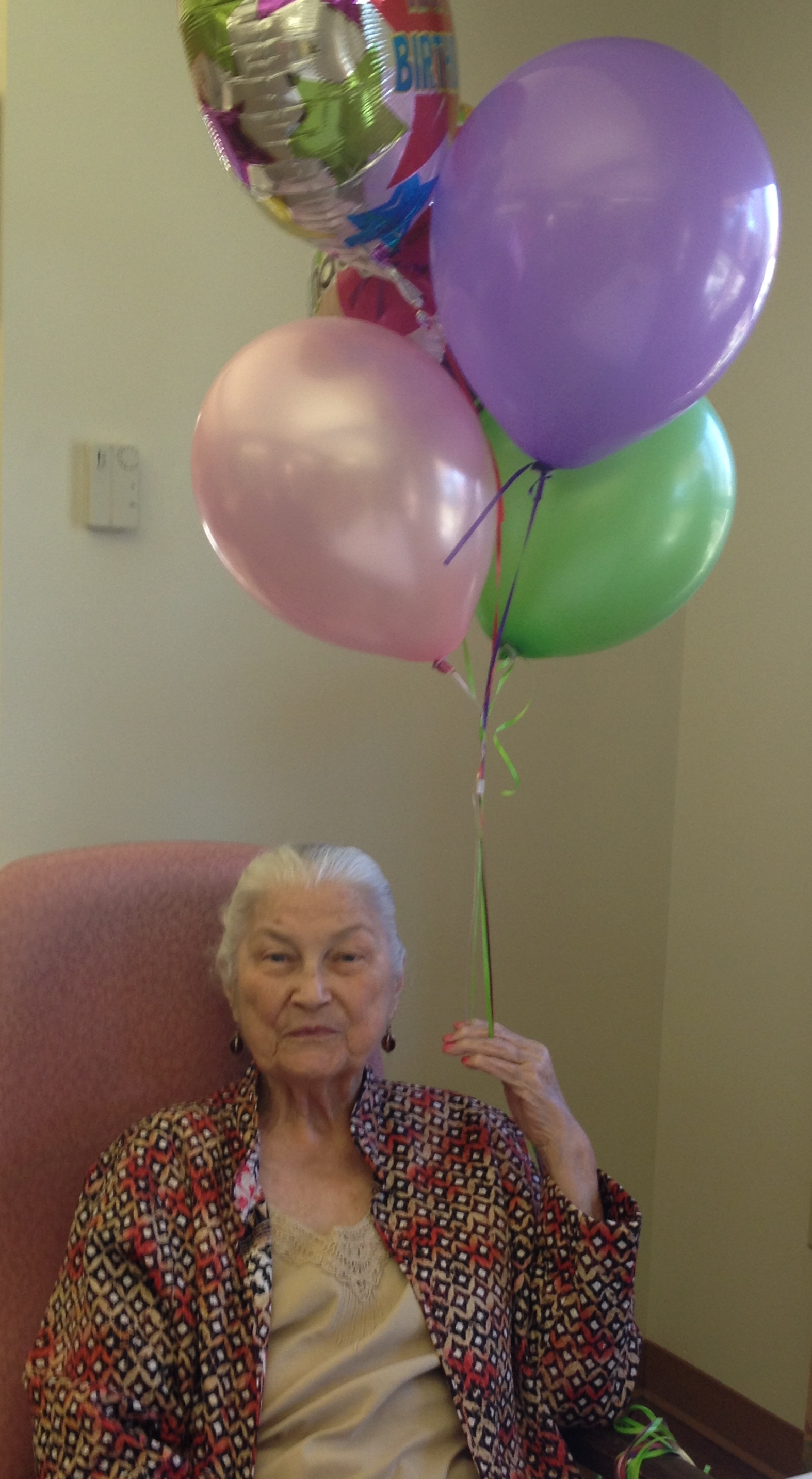
This year, Mother’s birthday looked different. She’s 92 and living in a care facility, diagnosed with dementia. There was cake and and pink lemonade, flowers and balloons, and lots of love for my mother. My sisters and I didn’t know if the residents would want—or be able—to sing, but one of them started belting out “Happy Birthday” so we joined in as best we could.

Mother stood up and thanked them, smiled over at her three girls, and made sure folks got second helpings.