{On Minding My Mother: “Give Me Just a Minute”}

IMG_1631Last month, while visiting with my mother, 92, we danced the dance we’ve adopted since her dementia diagnosis about two years ago. We change it up as appropriate, depending on how she’s feeling and how I’m handling how she’s feeling. Some days it’s jazz like, where we make it up as we go along with a lot of zigging and zagging and very little rhythm. On other days it resembles a waltz, with smooth and deliberate steps. Always, one of us leads and the other follows. For the most part it starts out like this:

She looks at me intently for several seconds before breaking into a smile that cracks my heart a little more each time: part surprise, part gratitude, and still, thankfully, part recognition. All the while I’m smiling back at her, trying not to panic, resisting the temptation to burst forth with, “Surely you remember me, your favorite daughter!”

“Oh sweetheart,” she says, coming close to hug me. “I didn’t know you were coming.” Which is often true, as I’ve been advised by counselors to say “I’ll get back as soon as I can,” instead of “I’ll see you tomorrow,” in case my plans change and Mother is left hanging, waiting for me to drop by. (I live in Tennessee and she’s in Mississippi in a residential facility.) Just as sure as I told Mother I’d be there on a certain day, at a specific time, she’d be lucid enough to hold me accountable. And trust me when I say you don’t want that kind of guilt weighing on you, getting a call that says, “Your mother is waiting for you. She’s anxious that you’re not here when you said you’d be. And she’s all dressed up. With her purse in her lap.”

On this particular visit I could not recall the name of another resident while Mother and I were talking. I’ve known the woman forever, grew up with her children, and yet I couldn’t bring her name to my mouth.

“You know, Mother,” I said, pleading and pointing toward the hall. “The woman who lives just up the way from you. The one with the—“

“Give me just a minute,” said Mother, interrupting me and holding out her right hand in a “stop” position. “Let me think.”

She came up with the name shortly thereafter and presented it to me without fanfare. Just another mother helping her child.

Loving Martha: On Memory and Mother’s Day

Martha
A favorite picture of Mother, taken on her last trip to the Chautauqua Institution, where we often vacationed together.

This is my family’s second Mother’s Day since Mother’s diagnosis of dementia. And it’s the first one that caused me to hesitate and wonder, “Do I send her a card?” Whereupon I immediately felt sad, and guilty, and utterly unsure of myself. Who questions whether to send their mother, a much beloved woman, a card?

Last year we were all on auto pilot, I guess, trying to keep everything as normal as possible. This year I cannot deny how much things have changed for us. I wasn’t concerned that Mother might forget reading the card minutes after she opened it. I was worried that she might have forgotten me.

It’s one of the things that scares my sisters and me most, that our mother might not know us one day. “Don’t borrow trouble,” friends advise, and I try not to, even though I’ve spent much of my life doing just that, long before things went wonky with Mother. (I won’t bore you with all the things I’ve worried about that never came to pass. You can thank me later.)  It may be that Mother will recognize us until the day she dies. But the very real possibility that she won’t pops up now and again.

I’m the youngest of three daughters. No sons. My sisters are ten and seven years my senior. As a teenager, it didn’t occur to me that I might have been a surprise. Occasionally I noticed that my friends’ parents looked younger than mine—my parents were forty when they had me—but I didn’t resent it or spend too much time trying to figure out what it might mean for my future. I liked hanging out with adults, and I grew up wanting to be older. I wasn’t scared of middle age; I longed for it. In so doing, I suspect I missed out on some youthful—and perhaps necessary—experiences. But it suited me, this way of being brought up.

“We treated you like you were thirty from the time you were six years old,” my father would joke.

On a ferry from Wood’s Hole to Martha’s Vineyard some twenty-five years ago, I asked my mother if I had been a mistake. I don’t know what made me pose the question then, but it was one of those moments of deep connection in which nothing seems off limits. We were two women on a road trip from Washington, DC, where I was living at the time, to New England. We’d toured the Rhode Island School of Design in Providence, shopped for antiques in Connecticut, and were now bound for the Black Dog Bakery.

“Of course not,” she said, facing into the wind. Then there passed one beat of silence, two. If I were telling you this story in person I would snap my fingers twice for effect.

“But if you were,” she added, turning to look me straight on, “you were the best mistake I ever made.”

I did send the card, the day before I read this, written by a woman I worked with in another lifetime, Paula Spencer Scott. She hired me for my first gig out of graduate school, working for Whittle Communications, which I count as one of the highlights of my career. Now she’s an accomplished writer and a contributing editor over at Caring.com, and she’s had family members with dementia and Alzheimer’s. When suggesting things to do for your loved one with memory issues, Scott advises, among other things, to “Keep giving cards. She might not remember opening it five minutes later, but so what? What matters is delighting her in the moment.” (www.huffingtonpost.com)

I’m learning a lot about that these days, being “in the moment.” Spending time with Mother brings it all to the here and now. When you’re holding your ninety-two-year-old mother’s hands, noticing how much the pinky on your right hand resembles hers, both now crooked with arthritis, and telling her the same story you just told her a half hour earlier, it anchors you to this very minute. It’s all we’ve got anyway, right? So I will sit, and I will listen, and I will love.

Stealing My Neighbor’s Daffodils

IMG_3425When I was about five, my family moved from one subdivision to another in my hometown of Jackson, Mississippi. Soon after we arrived, a woman came from next door to welcome us to the neighborhood. Mother told me to go out back and play while they visited. So I did. After roaming around for a bit with my Labrador sidekick, Sloopy, I found the longest row of daffodils, all yellow and good smelling, lining one side of the yard. I picked a bunch of them, delighting in my discovery, and took them in to Mother, my chubby fingers wrapped around the stems.

“Here,” I said, offering up my bounty. “These are for you.”

“Oh no,” said my mother. “Those don’t belong to us. You shouldn’t have done that.”

Somehow she knew what I didn’t, that the flowers bloomed on the property next to ours, owned by the nice woman sitting on the couch. She was lovely about it, this new friend, but my mother was not amused.

The neighbor, Mrs. Wise, and I laughed about it when I was older, with her telling me I could pick those flowers anytime, that she just wanted people to enjoy them.

The last time I saw her she brought a card to my father in the hospital after he collapsed in a restaurant while eating lunch. Once again Mrs. Wise and I spoke of the daffodils, although she was well into her eighties then and said she had no memory of my indiscretion. Why would she?

Why do I? Because of the shame of it, perhaps, one of those early scoldings we think we didn’t deserve. An early embarrassment. Or maybe it was my first meaningful encounter with a daffodil.

“But I wouldn’t have minded if you picked those flowers whenever you wanted,” she said as we visited in the lobby of Baptist Hospital on North State Street.

“This is for Earl,” she continued, handing me the card. “Get well soon,” it read.

Daddy died the next day, Mrs. Wise several years later.

Every spring when I pick daffodils in my own yard in Tennessee, I think of them both, a neighbor and a father who made lasting impressions on me.

On the Occasion of Mother’s 92nd Birthday

IMG_3336When my precious mother turned 80 in January 2002, my sisters and I hosted a lunch in her honor at the small church my parents had helped found in 1956. There was chicken spaghetti and cake, flowers and balloons, and lots of love for my mother. People told us how much she had meant to them over the years, shared stories about my sisters and me, and remembered my father, who died in 2000, with affection. Mother stood up and thanked them, cried a little when talking about Daddy, and made sure folks got second helpings.

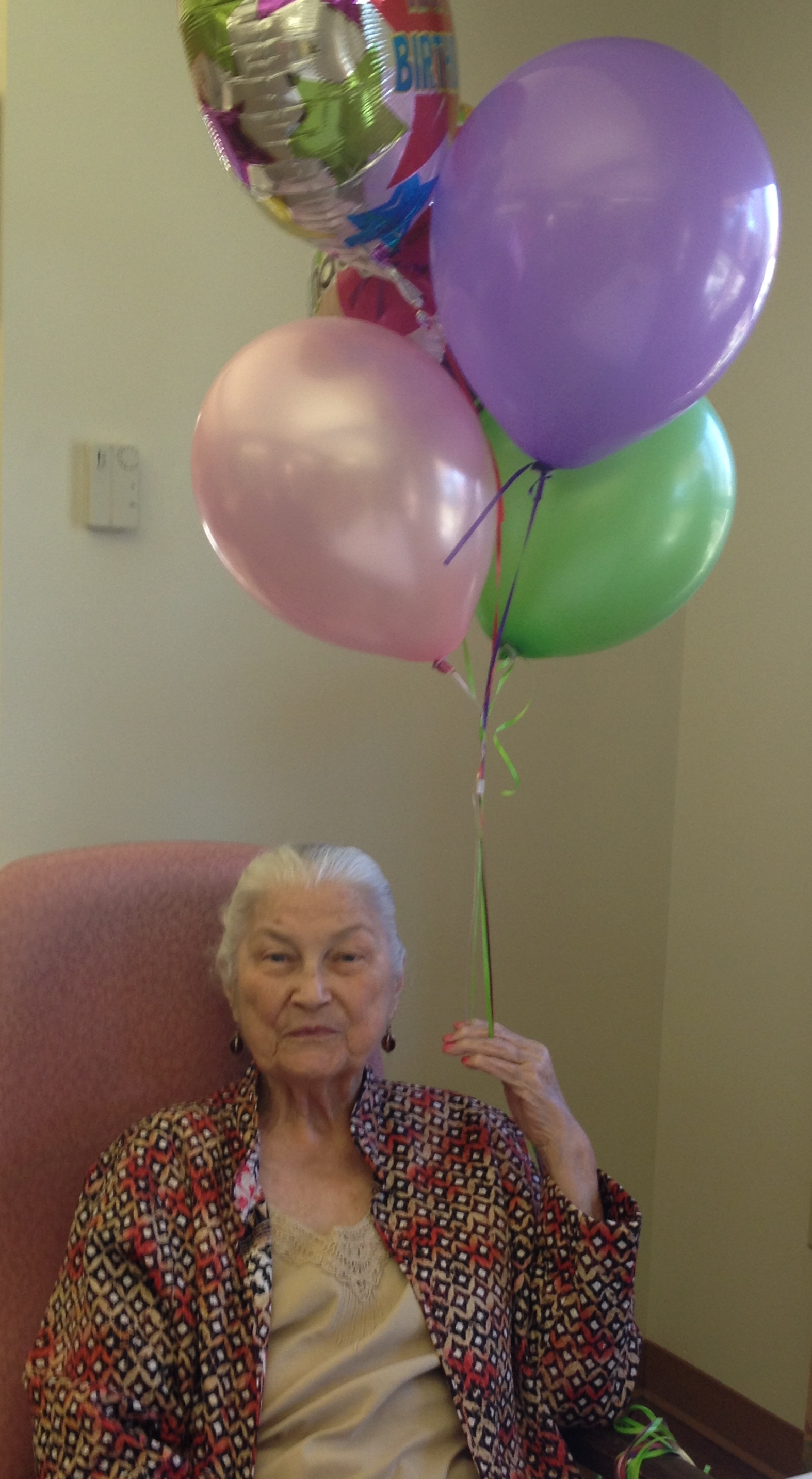
This year, Mother’s birthday looked different. She’s 92 and living in a care facility, diagnosed with dementia. There was cake and and pink lemonade, flowers and balloons, and lots of love for my mother. My sisters and I didn’t know if the residents would want—or be able—to sing, but one of them started belting out “Happy Birthday” so we joined in as best we could.

Mother stood up and thanked them, smiled over at her three girls, and made sure folks got second helpings.

Christmas Past

IMG_3294What the ornaments hanging on this wreath lack in finesse they make up for in memory, and tradition, and family. Like when my father was still alive, his arm wrapped around whichever of his three daughters happened to be within reach. When my mother didn’t have a diagnosis of dementia, and we painted wooden cutouts shaped like snowmen and Santas. When my sisters and I were young. These ornaments are as much a part of me as my green eyes and my tendency toward impatience. I pack them up with a heart made full by tenderness for what was, gratitude for this present moment, and acceptance of what will be.