
“This Could Be Serious” {Every patient has a story.”}

img_6613

I don’t have to wait long to be seen—maybe because I’m so sick or maybe because the doctor from the walk-in clinic alerted the ER, as she said she would—but I am in the waiting room long enough to be reminded what a microcosm of the human condition the hospital is: All walks of life brought together by all sorts of maladies. People whose paths you quite likely would not cross save for the fact that you are all in need of medical attention.

One woman complains that others, who came in after she did, are being seen before her. Another alerts us to the children who are playing with plastic spoons near an electrical outlet.

“If those were metal those kids would get shocked. Electrocuted, maybe.”

An older man eats a hamburger, a teen texts, and I think I recognize a lady from my church. There is just enough time for me to begin (okay, so I’ve been doing it since I woke up) ruminating on chance, luck, Divine purpose, the vagaries of life, before I’m called back by a nurse.

I’m put in a room, and the blood draws and IVs are underway almost immediately. My nurse, the first of several, is lovely. She talks me through everything she’s doing. I feel so bad I don’t really care what they do to me, but I appreciate her treating me with respect.

This is what I am thinking: This is how people find out they’re really sick. Someone’s husband is parking the Subaru with the dog slobber on the backseat windows and a doctor comes in and says something life-changing. On an otherwise normal day, people get bad news all the time. This is how it happens, without fanfare or warning or your loved one having time to get back from the garage. You have a fever and no energy and your life unravels. The old “Why me? Why not me?” toss up.

I begin to weep.

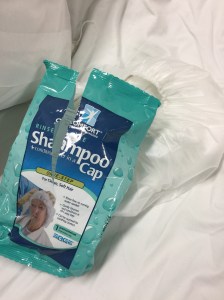
It’s an actual room, not just a curtained corner, so I do have privacy, which is nice. When it’s determined that I’ll need to be admitted, and there’s not a room available, the nurse has a hospital bed brought in, so I can get off the thin mattress that reminds me of the fold-out mat I used in kindergarten at naptime. It is a thoughtful thing to do and I am grateful. Any comfort–like the nothing short of a miracle shampoo shower cap–in this storm feels like a life preserver.

There is a lot going on out there.

Someone (as I make my way to the bathroom later I see a policeman in the hall) yells for a man to get back in his room. Apparently he doesn’t realize that being under arrest means you can’t just go tooling around the ER willy-nilly.

Several medical professionals come and go from my room. I am asked the same questions by different individuals. I think my answers are pretty consistent: Been feeling a bit poorly for a week or so but not alarmed until this morning; no I haven’t been out of the country; no I didn’t notice a tick or a rash on my body; yes I get yearly physicals; no I haven’t seen blood in my urine; no I don’t smoke.

One man, let’s call him Doctor X (not his real name) shall we, pulls a chair close to the bed and gets even closer to my face.

“Ms. Wilson.” Pause. “What do you think is wrong with you?”

His tone makes me feel like a kid, when my mother would ask me, “What do you think you did wrong, sweetheart?” (For the record, she did not have to ask me this often as I was an exemplary child. Or so the story goes.)

“I have no idea,” I say, when what I am thinking is more along the lines of, “If I knew, I promise I’d tell you. If I had a nagging suspicion, a mere inkling, any semblance of intuition, a scrap of insight, I’d share it with you.”

He makes me feel as if I am holding something back, as if I don’t want them to know everything they need to know in order to figure out what is happening with my body.

“What about HIV? A lot of times these low white cell counts indicate HIV.”

“I don’t think so,” I said.

“You’re not at high risk, you don’t think?”

“No sir.”

“Multiple sex partners? Drug use?”

“No sir.”

I don’t have the strength for regaling him with all the reasons I don’t think I’m a candidate for HIV, and I feel so bad I start to think maybe I’ll be some fluke case of contracting it. It could happen, I guess. I don’t have an issue with the testing; test away. I have an issue with the delivery. Why not something like, “It’s standard for us to test for HIV when we see such low white counts.” More equalization; less shame.

“Okay, well. You need to know that this could be serious.”

Again, maybe you could try: “We don’t know what’s wrong with you but we’ll do everything we can to find out. It could be an infection, or it could be something more serious.”

So, um, Doc, I’m already convincing myself I might be dying. I’m in the ER, so I get it, that this might be serious. To me it already is. I’m way ahead of you.

Doctor X leaves and comes back so fast I’m surprised he had time to turn around.

“I’m testing you for HIV.”

“Okay,” I say. “Fine. Of course.”

Call Me When You Get There

Before I married, at age forty-one (yes for the first time), I had just about had it up to here with friends patting me on the shoulder and saying, “You’ll just know.” They were trying to make me feel better by telling me I would know when the right person came along. They were assuming that the right person would show up, even though my father taught me early on that there are no guarantees in life. I never dreamed of a knight on a horse, or even a banker in a Buick. So my friends thought they were making me feel better when I didn’t even feel bad to start with. I did, however, often feel worse after they fussed over my singlehood all the while regaling me with stories of their idyllic couplings and pictures of their perfect children.

It didn’t seem like the end of the world to me that I might live my whole life without marriage. I suspected it would be more fun with a partner, and there were Friday nights when I felt desperately sorry for myself, but I did not consider pairing up a prerequisite for a fulfilling and happy life.

“Why haven’t you married?” people would ask me. This seemed to me a preposterous question, one that answered itself. I hadn’t married because the right opportunity had not presented itself. The crush from high school didn’t ask, and I didn’t trust—or love—the one who proposed in my twenties. Plus, I think he was drunk at the time.

“Maybe you’re expecting too much,” friends would say, when all I really expected of myself was not to marry for the wrong reasons.

“What are you looking for?” they would surely inquire, and this one I had an answer for: Someone who cares whether I get home safe and sound. Someone besides my parents. I had often joked that the man who said these words to me, preferably while holding me close or leaning in to kiss me, would be the one: “Call me when you get home so I know you’re okay.”

So when, a few days after our first date, as I was preparing to leave my hometown where I was visiting and return to Nashville, where I live, Precious tapped on the driver’s side window as he stood in the parking lot of the coffee shop where he’d bought me a “sweet roll” for breakfast and said, “Please call me the minute you get to Nashville so I won’t worry about you,” I just knew.


Mother Knows Best

MarthaAndMe
A favorite photo from several years ago, before Mother’s dementia diagnosis.

Back in January 1922 my parents were born four days apart. My father in Bell, California, and my mother in Tula, Mississippi. They would meet several years later at elementary school when my father’s family returned to its southern roots, and they married in 1948.

Although there were balloons and decorations and cake for my mother on her birthday earlier this month, she would not have known it was her day unless someone had made a fuss. Her dementia robs her of a lot, such as keeping up with dates and important life events. She sometimes thinks her parents have just died and that she wasn’t able to get to their funerals. I hate this for her, that her mind is not only failing her but is also tricking her, goading her into thinking she failed her parents. When, in reality, she was a devoted and faithful daughter until the very end, when she saw her mother and father across the bar and into the ground at St. Peter’s Cemetery in Oxford, Mississippi.

So she loses memories and facts, but she retains her grace, and her humor, and her kindness.

At Christmas I held her hand while we watched part of “Miracle on 34th Street,” which I had never seen and for some reason insist on referring to as “Miracle on 51st Street.” I left after Santa was put in the hoosegow, so it is my fervent hope that the poor man got sprung before the movie was over.

When I arrived that day at the residential facility where she lives, she was resting in her chair with her eyes closed. I sat on the edge of her bed and waited for her to wake up. When she did, she took a few seconds to stare at me with love.

“I recognize you,” she said, smiling.

Her eyes were clear and lively, not dulled as they can sometimes seem when she is having a harder time focusing and engaging. It was the same smile I have seen on her precious face countless times before, an upturn of her lips that let me know she is still my mother.

Show Me Your Scars and I’ll Show You Mine

IMG_3730.jpgI didn’t realize I was sick back then—just miserable. I knew I didn’t belong in law school, though everyone around me said I did. Problem is, you don’t drop out in my family. Wilsons persevere.

“I think something’s wrong with your thyroid.” This from my mother at the Thanksgiving table after my dismal semester. Turns out a goiter had sprouted in my neck and I hadn’t even noticed. That’s how out of touch I was with myself, people. (Google “goiter” at your own risk.)

“You better go see Doc Murray when you get back to Oxford.”

I did and it was. The kindly and charming old-school doctor sent me to a specialist, a not kindly and especially uncharming man, who glanced at me and said: “Most times this is cancer.”

My twenty-two-year-old self started crying and ran to call my parents.

“Come home,” they said. So I did. We got another specialist. A nicer one.

After the surgery to remove half my thyroid gland, I didn’t really mind the scar, even early on when it was angry and red. It proves I can weather the storm, if you will, that’s the way I see it. Cliché or no.

“I can fix that for you,” said a doctor acquaintance at a party not too long ago. He was tilting his head toward the base of my neck and stabbing for an olive with one of those plastic cocktail swords. Red I think it was.

“Fix what?” I asked. I wasn’t even trying to be coy, as I don’t think about the scar, which looks a little bit like a short, braided rope.

“Your thyroidectomy scar. The surgeon should have done a better job. You know, so it wouldn’t be so noticeable.”

Maybe your mother should have done a better job with you, I wanted to say. You know, so your personality wouldn’t be so bothersome.

“I don’t want it fixed,” I said instead. “But thank you for your concern.”

Besides the small rough patch on my right hand—a neighbor’s German Shepherd jumped up on me while I was riding my bike (boy was I proud of that banana seat) and I ended up in a puddle of gravel—I don’t have other visible scars. (I’ve had more surgeries, laparoscopies and such, but no additional physical reminders of trauma.)

My mother, bless her precious 93-year-old heart, is riddled with scars: colon cancer, mastectomy, gallbladder, vena cava filter, skin tears every time her body tricks her into thinking she doesn’t need to use a walker and she pitches to the floor.

I don’t know if she minds her scars or not. I could ask her, but the answer might not be based in reality, as dementia is robbing her of such. She doesn’t seem to mind them, though, or much of anything, actually. Instead she comes across as content, happy even, in the moment. She no longer seems anxious and does not spend her days borrowing trouble, a favorite pastime of hers that I’m sorry to say I have inherited.

Usually she just smiles, asks me if I’m her baby, and rolls herself into the dining room to join the other old souls who can no longer live on their own.

“Yes, ma’am,” I say. “I am.”

Scars and all.

Amy Lyles Wilson

Writing Prompt: Read Lucille Clifton’s “Scar” and write about what it brings up in you. Write for 20 minutes. I’ll set the timer. Go!

http://www.sunsetcoastwriters.com/blog/scar

On Dreaming {Waking Up Worried}

dsc_0066.jpgThis morning I woke up wondering how to make amends for having offended someone. We were at a conference and I’d tried to sit next to him during the lunch break.

“You can’t sit here,” he said. “I don’t want to be around you because I saw you do something I didn’t like.”

It might be merely sad if I were worried about someone jerky enough to refuse to sit by me because of a perceived slight I might not even have been aware of making, but the thing that makes my concern even more pathetic is that it was all a dream. After dreaming about a man, someone I did not recognize from my waking life, being rude to me, my response was to blame myself and beg for forgiveness. All this before I’d even brushed my teeth.

This can’t be good, right, that I allowed a dream to make me doubt myself? That my first inclination upon waking was not, “What a beautiful morning” (which it is here in Nashville) or “Aren’t I lucky to have a husband who brings me coffee?”

Instead, I opened my eyes and thought: “I can’t believe I made this guy so angry with me. What could I have done wrong?” Blink. Blink. Blink. “What can I do to make it right? How can I make him like me?”

“That’s a stretch even for you, Babe,” said Precious when I told him I woke up worried. “Usually we make it to noon before you take to fretting.”

I think he was kidding, but he knows I’m an anxious sort, that I have the potential to assume responsibility for actions that take place five counties over. That I can imagine all manner of things to be sorry for just sitting in the den.

But I’m working on it. I’m learning the art of presence. I’m practicing being centered in today instead of borrowing trouble against tomorrow. I yearn to be respectful of, and grateful for, this very instant. This one right here. I don’t want to be the kind of old woman who wanders too far afield into the unknown of the future or stays mired in the over and done with of the past. Today, though, I feel like my dream conspired against me.

~ ~ ~ ~ ~

In training to be a spiritual director, we’re doing dream work, which is new to me. We’re asked to make notes of our dreams and sit with images that come up. Maybe this dream is inviting me to let go of what people think of me. Maybe this dream is reminding me that I can’t control how others react to me and that, alas, not everyone will like me. (This one still breaks my heart, that not everyone thinks I’m fabulous. And that there’s not a darn thing I can do about it.) This wouldn’t be the first time such propositions have been hurled in my direction. Maybe now I will get the message. If not, there’s always tonight, where another dream awaits.