
Gathering ‘Round Our Grief

IMG_1447This cabin in the woods is empty now, but on two rainy days in early June it embraced twenty-four souls who gathered together to write their hard stories, the ones they can’t share with just anyone. Sometimes not even themselves. Not quite yet.

When I preach, “It’s the sharing of our stories that saves us,” I mean it, whether you whisper your story to yourself, mail it to your Uncle Bud, or shout it out for the world.

Not everyone who came to write with us during the 2018 Haden Institute Dream and Spirituality Conference at Kanuga shared aloud what they’d written. They didn’t have to, and that was part of the deal.

“Come write,” I say to anyone who will listen. “That’s all you have to do. You don’t have to say a word if you aren’t moved to do so.”

Even that—the writing—is, of course, challenging. I tell clients that writing is as hard, and as easy, as “Just do it.”

After we wrote in response to prompts in the little cabin, when I asked for readers, three women sitting together would, all at once as if they had practiced, shift their eyes toward the floor. Like synchronized swimmers. They made it clear they didn’t want to speak. I didn’t compel or cajole or criticize. I let them be.

Later, two of the ladies would tell me they just couldn’t talk, but that afterwards, in the privacy of their room in the lodge or on a bench by the lake, the words—and the tears—came. They were grateful, they said, and I reminded them that they had done the work. All I did was invite them to try, make the space as safe as I could, and remind them they are not alone. That’s one of the best things sharing our stories can do: Connect us to others—those who grieve just like we do—which is everyone, if they’re honest. All of us have it, that thing that threatens to silence us and prevent us from engaging fully with the life that remains. The life that is.

You might miss your father, dead some twenty years, while the person next to you in the grocery checkout mourns the children he never had. Your neighbor regrets marrying her husband, and your yoga instructor hasn’t spoken to her sister in three years. We’ve all got something.

My goal is not to force people to dwell on what might have been or is no more. Instead, I encourage people to put into words those tender parts of life so that they might gain a little perspective, perhaps. Make a little space in which they can take a breath between the loss and the present day in order to better absorb and honor the gap. We live more fully when we take it all in, even the loss. Maybe especially the loss. I am among those who believe our greatest gifts are uncovered in our greatest tenderness, those places we hesitate to touch for fear something might break loose. Famous people have said it better than I can, like Henri Nouwen:

“Nobody escapes being wounded. We all are wounded people, whether physically, emotionally, mentally, or spiritually. The main question is not ‘How can we hide our wounds?’ so we don’t have to be embarrassed, but ‘How can we put our woundedness in the service of others?’ When our wounds cease to be a source of shame, and become a source of healing, we have become wounded healers.” (henrinouwen.org)

I believe that “service to others” begins with our willingness to connect to our fellow pilgrims through our hard stories. Heartache to heartache, soul to soul. Story to story.

Go Collect Yourself

IMG_1875The dream came over the weekend, the one with her dead mother in it. MayBelle hasn’t dreamed about her mother regularly in the two years since her death, although MayBelle often senses her mother’s spirit with her. And certainly she feels her mother’s influence, even lives it out. On separate occasions just last week, MayBelle quoted her mother to a friend, heeded a piece of advice delivered decades ago, and missed her with such fierceness that she had to step outside a restaurant to collect herself.

Maybe MayBelle will make that her Lenten practice, “collecting herself.” She will gather up the pieces she’s lost hold of, the ones she either thought didn’t matter or was told didn’t count. She’ll root around for her childhood dreams and begin to honor those goals she let fall by the wayside. She’ll walk as far as she has to, searching for the just-right shards and fragments. Hers.

Along the way, MayBelle will have to put down some things, she realizes, for one middle-aged goober can’t carry it all. She’ll start with that pesky self-doubt and the tendency to see herself through a distorted lens. Then she’ll move on to a constant need for approval and an everlasting refrain of: “You are not doing enough.”  She’ll get rid of clothes that don’t suit and accessories she doesn’t need. (Why in the world did MayBelle buy that mustard-colored sackcloth tunic?) Out with the affectations that never did the trick anyway, and say goodbye to being unduly influenced by every piece of advice—sought or otherwise—that comes her way.

As she hunts and gathers and sets aside, MayBelle will focus on collecting what counts and what connects. All she cares about and all she can offer. Those dreams, people, and activities she can tend and nurture well. She hopes she will need a big basket to hold it all. For now, MayBelle will start with this basket, one her mother used for taking food to potluck suppers at Briarwood United Methodist Church. MayBelle knew she kept the basket for a reason.IMG_2684

In the dream, MayBelle’s mother is happy. She is not worried or anxious. She is not scared of the dementia that garbles her memories, or the death that looms. Instead, she is laughing merrily with one of her precious great-grandchildren, a young girl with a big bow in her hair who pushes MayBelle’s mother in a wheelchair. They are both smiling, big toothy grins, as they loop round and round. They exhibit such joy that MayBelle chooses to believe it is more than a dream. It is the stuff of life.

Estate Sale Blues {On What’s Left Behind}

IMG_3368
Seen at yet another estate sale. MayBelle’s mother used to wear Ferragamos, before she got so old, she’d say, that she had to trade fashion for function.

Often MayBelle doesn’t miss her deceased parents on those days you might consider made for mourning: death anniversaries, family birthdays, major holidays. Most likely she begins to cry, or is forced to her knees, at unpredictable times and in unexpected places.

Like this weekend, when she went to an estate sale, the kind where it’s obvious someone has left the house for good, as opposed to a garage sale intended to make room for more stuff. What’s left is what’s left behind, after the inhabitant has died or moved to a retirement community or skilled nursing facility, perhaps. For some reason, in her mother’s final days, MayBelle much preferred “skilled nursing facility” over “nursing home.” She was choosing her words deliberately, she surmises, so that she might survive the fact that her mother could no longer care for herself in a meaningful way.

MayBelle knows the territory because she’s been there, deciding what stays in the family, what gets donated or sold, what needs to be discarded. How to choose between a memory and a marble candlestick? Indeed.

As she made her way through the tidy townhouse, MayBelle looked for old postcards and photographs, small things she might use as writing prompts or for her art projects. Exiting a bedroom she glanced in the closet, where she noticed clothes like her mother wore in her later years: matching, machine washable, sturdy with a hint of style. MayBelle began to weep, seeing the same brands she and her sisters used to buy for their mother, clinging to any last gesture they might offer her when so much had been taken away. For a while there, MayBelle could tell any woman of a certain era where to get the best deals on Alfred Dunner and high-waisted cotton underwear.

MayBelle is what’s known as a “highly sensitive person”—yes, it’s a thing—and she can be moved to despair at warp speed. Bless her heart. She is also a person with an estate sale problem. Probably she should not spend so much time rummaging around in the pasts of strangers, as it often makes her sad and she does not need even one more tea towel. But this weekend it is where MayBelle found herself, wondering what had happened to the homeowner (was it a happy life?), forking over eleven dollars, and missing her mother.

Dog Love {On Losing a Pet}

Sloopy copy
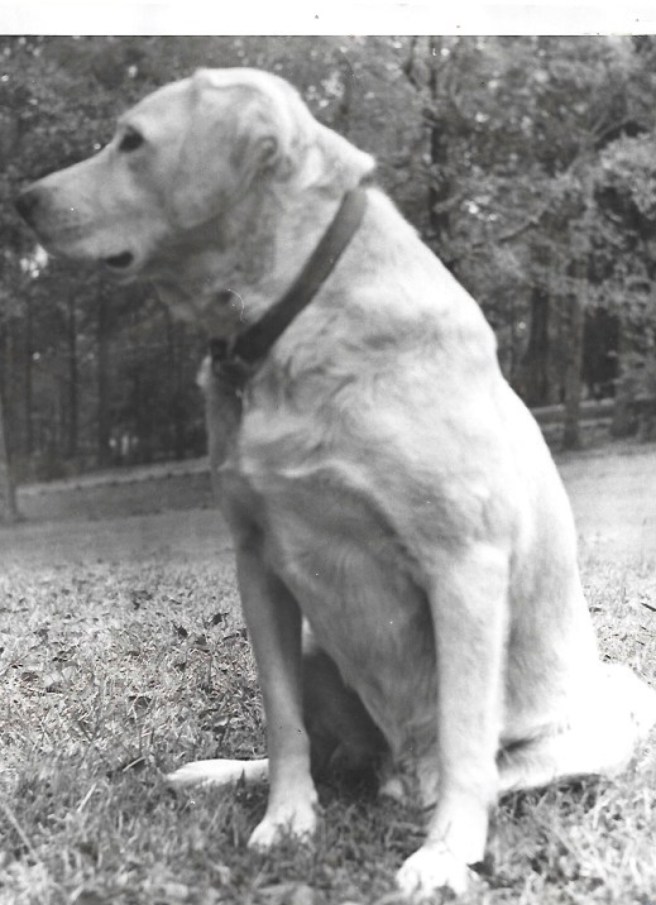
Sloopy: The Beginning of MayBelle’s Dog Love

Sloopy was the dog of MayBelle’s young childhood, a sweet, block-headed lab who was her constant companion. When MayBelle looks at old pictures now she wonders if she had any friends at all, so often does she appear with the dog.

Then there was Savoy, and Rasta, and F. Scott. And, in her thirties and forties, Quay, who was the dog of MayBelle’s adulthood, by her side as they made their way in Nashville, just two. When Precious came along he was warned that he had to pass muster with Quay Girl or the dating deal was off. At their first meeting, Precious got down on his knees and rubbed Quay under her chin, resulting in two smitten gals instead of one.

Quay Girl was MayBelle’s heart. She was scared of thunderstorms, wary of screaming children, and shed her mixed-breed hair like tumbleweeds. She was also fiercely protective, a great traveler who never threw up in the car, and prone to trying to curl up on MayBelle’s chest long after she had grown too big for such. Her fatty tumors came, as they do sometimes in older dogs, and then it became clear she also had cancer throughout her system. MayBelle and Precious knew it was the humane thing to do to let her go at age fourteen. MayBelle cried for days.

Then came Hiram, a West Highland Terrier chosen for his low shedding properties, as Precious is allergic. Hiram was the smartest dog they’ve ever had the pleasure of tending to. Stubborn, funny, endearing, and dead at only seven and a half. MayBelle and Precious are bereft.

If you are a pet person, what is it about these creatures that crawl on our laps and steal into our hearts? Chew our furniture, demand our attention, and calm us like nothing else can?

Recently a piece about people who refer to their dogs as their children made the rounds on social media. The writer was outraged that anyone would presume to compare a pet to a child. MayBelle gets it, really she does, that dogs are not people. And as cute as she thought Hiram was, he didn’t hold a candle to her great- nephews and nieces. But seriously, people, dog love is its own thing, and if it brings someone joy to spoil his or her pooch, what’s the harm? Sure, it sort of creeps MayBelle out when she sees dogs dressed up in human clothes, but she doesn’t feel moved to criticize their owners for it (not out loud, anyway).

As for MayBelle, she’ll spend her time on articles such as this one that proclaims the health benefits of pet ownership. That said, she understands that not everyone loves dogs like she does; even some of her own family members back away at the mere mention of slobber. (MayBelle is sometimes tempted to bring up “expressing anal glands” when around these relatives but so far she has resisted the impulse.) MayBelle, on the other hand, relishes the time with her canine companions and knows she will need one with her until the end of her days. There have been times in her life, after all, when a dog was the only living, breathing creature she’d see for days. It’s hard to let go of a bond like that.

So dress up your dogs, saddle them with family names (MayBelle’s personal proclivity), spoil them with treats and toys, post their pictures on Instagram. MayBelle, for one, doesn’t mind.

A Dream Realized {On Writing at Chautauqua}

Me, in a hat, realizing a dream.

On one hand, it might not look like much, for it’s just a picture of me in my favorite hat. And for those of you who know how much I loathe having my picture made, I’m actually okay with this one. Because it’s not about image; it’s about a dream come true.

Last week I had the honor of leading a writing workshop at the Chautauqua Institution (“The Language of Loss: Putting Grief into Words”). Since first stepping foot on that magical spot some twenty years ago I’ve known it would change my life. And it has.

I’ve learned a lot about subjects ranging from history to religion; made friends; eaten really good food at the Brick Room and the White Inn in nearby Fredonia, New York; heard Garrison Keillor, Carol Channing, and Salman Rushdie, to name just a few; wandered small towns with names like Ashville and Westfield and thereby come to love a part of the country I hadn’t known before. All that has been great. But now, now the best part is that I got to commune with creative-soulfuls for a week, people who were willing to write their hearts out with a stranger.

Each day we came, gathering around the table in an unairconditioned room in a former elementary school turned community center. We brought our pens and our journals and our deep-down stories. We opened the windows, turned on the fans, and wrote. In so doing, we formed a community where it was safe to tell our stories without fear of critique, or judgment, or comparison. No one cared about split infinities or potential for publication or increasing blog followers.

Instead, our concern was forming a kindred-spirit container for the sacred act of sharing those stories we don’t often get to talk about, the ones from the gut, the ones that hurt. Those writers were brave, and considerate, and willing. They were “good with words” and lovely with one another. I was inspired, humbled, and made grateful. Thank you, Chautauqua, for the experiences and the memories, yes. But especially the people.

Writing Prompt: What step can you take today, this very minute, toward realizing one of your dreams? I’ll set the timer for 20 minutes. Go!