Go Collect Yourself

IMG_1875The dream came over the weekend, the one with her dead mother in it. MayBelle hasn’t dreamed about her mother regularly in the two years since her death, although MayBelle often senses her mother’s spirit with her. And certainly she feels her mother’s influence, even lives it out. On separate occasions just last week, MayBelle quoted her mother to a friend, heeded a piece of advice delivered decades ago, and missed her with such fierceness that she had to step outside a restaurant to collect herself.

Maybe MayBelle will make that her Lenten practice, “collecting herself.” She will gather up the pieces she’s lost hold of, the ones she either thought didn’t matter or was told didn’t count. She’ll root around for her childhood dreams and begin to honor those goals she let fall by the wayside. She’ll walk as far as she has to, searching for the just-right shards and fragments. Hers.

Along the way, MayBelle will have to put down some things, she realizes, for one middle-aged goober can’t carry it all. She’ll start with that pesky self-doubt and the tendency to see herself through a distorted lens. Then she’ll move on to a constant need for approval and an everlasting refrain of: “You are not doing enough.”  She’ll get rid of clothes that don’t suit and accessories she doesn’t need. (Why in the world did MayBelle buy that mustard-colored sackcloth tunic?) Out with the affectations that never did the trick anyway, and say goodbye to being unduly influenced by every piece of advice—sought or otherwise—that comes her way.

As she hunts and gathers and sets aside, MayBelle will focus on collecting what counts and what connects. All she cares about and all she can offer. Those dreams, people, and activities she can tend and nurture well. She hopes she will need a big basket to hold it all. For now, MayBelle will start with this basket, one her mother used for taking food to potluck suppers at Briarwood United Methodist Church. MayBelle knew she kept the basket for a reason.IMG_2684

In the dream, MayBelle’s mother is happy. She is not worried or anxious. She is not scared of the dementia that garbles her memories, or the death that looms. Instead, she is laughing merrily with one of her precious great-grandchildren, a young girl with a big bow in her hair who pushes MayBelle’s mother in a wheelchair. They are both smiling, big toothy grins, as they loop round and round. They exhibit such joy that MayBelle chooses to believe it is more than a dream. It is the stuff of life.

Estate Sale Blues {On What’s Left Behind}

IMG_3368
Seen at yet another estate sale. MayBelle’s mother used to wear Ferragamos, before she got so old, she’d say, that she had to trade fashion for function.

Often MayBelle doesn’t miss her deceased parents on those days you might consider made for mourning: death anniversaries, family birthdays, major holidays. Most likely she begins to cry, or is forced to her knees, at unpredictable times and in unexpected places.

Like this weekend, when she went to an estate sale, the kind where it’s obvious someone has left the house for good, as opposed to a garage sale intended to make room for more stuff. What’s left is what’s left behind, after the inhabitant has died or moved to a retirement community or skilled nursing facility, perhaps. For some reason, in her mother’s final days, MayBelle much preferred “skilled nursing facility” over “nursing home.” She was choosing her words deliberately, she surmises, so that she might survive the fact that her mother could no longer care for herself in a meaningful way.

MayBelle knows the territory because she’s been there, deciding what stays in the family, what gets donated or sold, what needs to be discarded. How to choose between a memory and a marble candlestick? Indeed.

As she made her way through the tidy townhouse, MayBelle looked for old postcards and photographs, small things she might use as writing prompts or for her art projects. Exiting a bedroom she glanced in the closet, where she noticed clothes like her mother wore in her later years: matching, machine washable, sturdy with a hint of style. MayBelle began to weep, seeing the same brands she and her sisters used to buy for their mother, clinging to any last gesture they might offer her when so much had been taken away. For a while there, MayBelle could tell any woman of a certain era where to get the best deals on Alfred Dunner and high-waisted cotton underwear.

MayBelle is what’s known as a “highly sensitive person”—yes, it’s a thing—and she can be moved to despair at warp speed. Bless her heart. She is also a person with an estate sale problem. Probably she should not spend so much time rummaging around in the pasts of strangers, as it often makes her sad and she does not need even one more tea towel. But this weekend it is where MayBelle found herself, wondering what had happened to the homeowner (was it a happy life?), forking over eleven dollars, and missing her mother.

Missing Martha {On Mother’s Day}

IMG_7861
Martha Lee Lyles Wilson, 1922-2016

Last month my two sisters and I met in Oxford, Mississippi, to see our mother’s gravestone for the first time since we had buried her just over a year ago. We’d all made sojourns to the cemetery before this particular April afternoon, but it had taken a while for us to get the ledger in place. So we walked from The Square over to St. Peter’s Cemetery, around the small grouping of trees I think are cedar but don’t know for sure. Then, just past the curve of the road, we veered right to the Wilson plot on the hill.

It looked beautiful, elegant and classic, just like Daddy’s. “Well done, good and faithful servant,” it read. Ann, Ginny, and I got her as close to Daddy as we could. It’s where she liked to be in life, right next to our father, and she told me more than once, “that’s it for me,” after he died, some sixteen years before she did. She would quickly add that she still loved being with her family, but I knew what she meant, I think, for something life-giving abandoned her the day he died.

We had a ritual when we got back to Ginny’s house, putting out some pictures, lighting a candle, and telling stories of our childhood. I read a poem entitled “We Remember Them,” by Sylvan Kamens and Rabbi Jack Riemer, sent to me by soul-friend Sheri Malman when I told her what I wanted to do. She also managed to have a bouquet of flowers waiting at the cemetery for us, which contained calla lilies and roses, my parents’ favorites. That’s a good friend, people.

The last line goes like this: “For as long as we live, they too will live, for they are now a part of us, as we remember them.”

Let all those who miss their mothers on this day say Amen.

Somehow comforted by hearing Patty Griffin’s “Heavenly Day” on WMOT, the fabulous Americana station I listen to daily in Nashville, as I write, and remember.


A Eulogy for My Mother

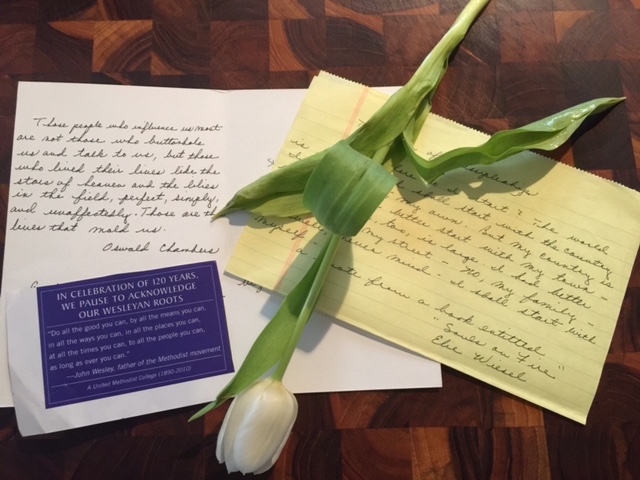
ALW-Mother-Eulogy-BlogInstead of regaling people with charming anecdotes about my childhood (dancing to “I’m a Little Teapot” in the living room) or relaying repetitive accolades (“Your mother was one of the most influential people in my life.”) about how precious my mother was—and she was dear—when giving her eulogy on February 23, I instead read three passages I dug out of one of my “memory boxes” while crying and packing my suitcase for Mississippi after my sister Ann phoned to say, “This is the call you never want to get.” Bits and pieces from a long life well lived that illustrate, better than a hundred family snapshots, what made Martha Lee Lyles Wilson (1922-2016) such a remarkable woman.
One was a quote she included in a birthday card she sent me; another was a passage she wrote on a sheet of yellow legal-pad paper; and the third was a quote she cut out from a magazine. In short, these snippets reveal how my mother made her way in the world, and how she inspired those around her to follow her lead as best we are able:

“Those people who influence us most are not those who buttonhole us and talk to us, but those who lived their lives like the stars of heaven and the lilies in the field, perfect, simply, and unaffectedly. Those are the lives that mold us.”—Oswald Chambers

“Do all the good you can, by all the means you can, in all the ways you can, in all the places you can, at all the times you can, to all the people you can, as long as ever you can.”—John Wesley

“But where do I start? The world is so vast; I shall start with the country I know best, my own. But my country is very large; I better start with my town—but my town, too, is large. I had better start with my street. No, my family. Oh well, never mind. I shall start with myself.”—Elie Wiesel

I don’t know if the quotes she clung to are punctuated or even worded exactly as they appeared in print, and to me it doesn’t matter. The philosophies are clear, and they now have a permanent place in my heart, right alongside my mother.

Rest in peace, good and faithful servant.

Obituary for Martha Lee Lyles Wilson


Keeping Kin

StPetersCemetry“I’m Earl’s youngest.”

I must have said it ten times as a reference point for people who looked familiar but forlorn as we came together to bury my aunt in Oxford, Mississippi.

My father’s been dead for fifteen years, and my mother is out of touch now due to dementia, but these folks—blood kin and otherwise—gathered at the funeral home on Highway 6 still link me to my heritage. They are my people.

Oxford is where my parents met in elementary school, attended University High, and were graduated from Ole Miss. It’s where my family went throughout my childhood to visit grandparents and aunts and uncles. Cousins. It’s where I had my first panic attack in my early twenties, realizing I didn’t belong in law school and that I was about to undo years of dreams–other people’s dreams–by dropping out. It’s where we buried Daddy. And it’s where I married the love of my life at age 41, in the same church where my parents said their vows in 1948. Lafayette County will always have hold of me.

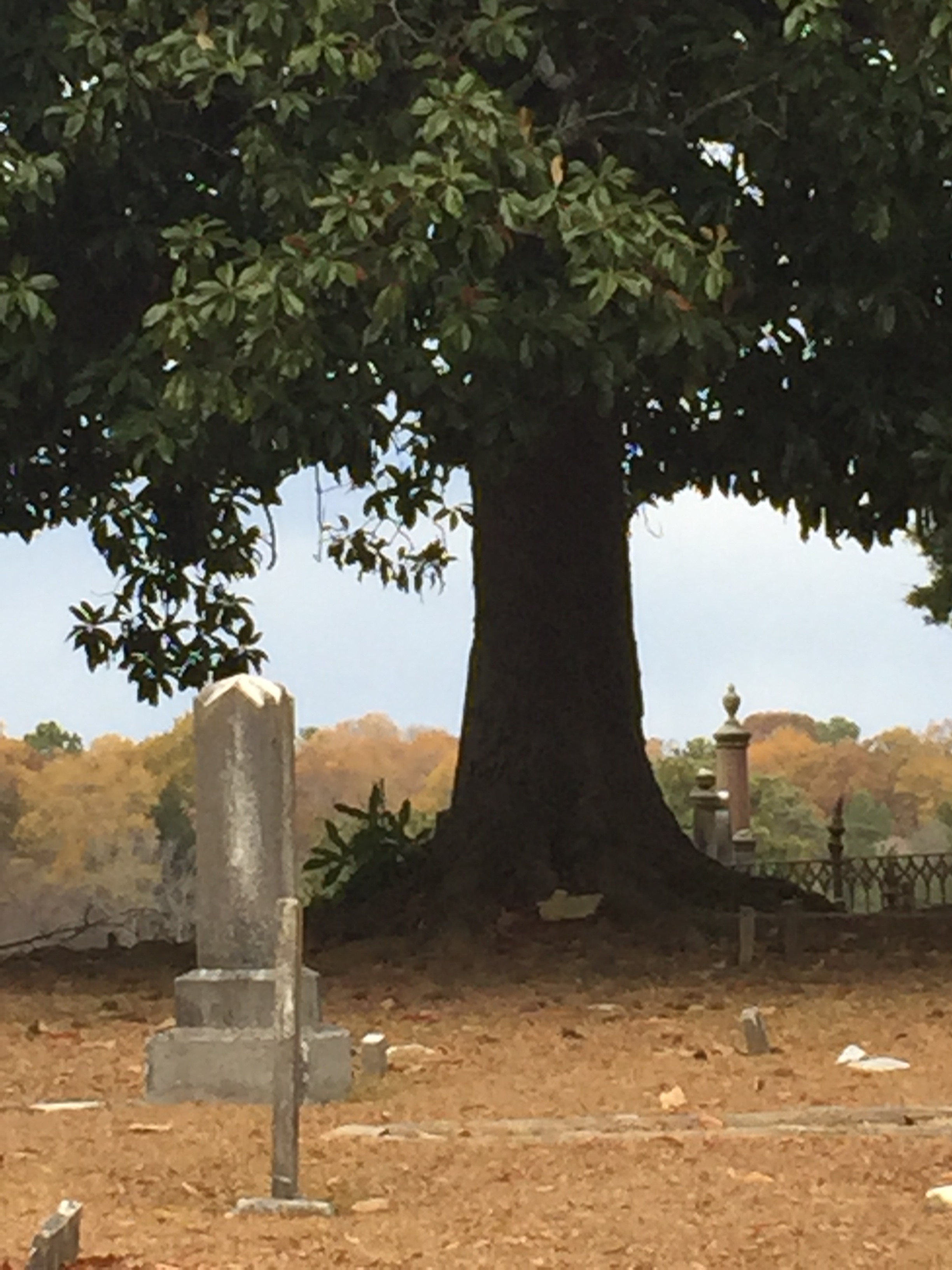
St Peter’s Cemetery embraces more family members than I care to remember. But remember I did, tiptoeing over ancestors as I made my way to the Wilson monument on the hill to escort another loved one across the threshold.

“We’ve saved a plot for you,” my mother said to me once when we visited the cemetery to place flowers on the grave of a Wilson or a Lyles. I was single then, and my “bless your heart” parents thought it would always be so, that I would end up next to them in death, close by, just as I had been for most of my life. Too close, perhaps. It did not seem the time or place to tell her I plan to be cremated, married or spinster, my remains cast to the wind hopefully in North Carolina, where I feel more at home than I ever did in my hometown.

“Thank you,” I said.

My father is there, both his parents, my mother’s parents, too, second cousins twice removed, a couple of relatives I have no clue about (why don’t I remember Roxie Malinda?), and a precious child who died soon after birth. They’re all accounted for, surrounded by friends known to several generations of my family. I recognize names like Clark and Howell and Ivy from years of recollections offered up during holiday dinners and family reunions.

When I was younger—I’m 53 now—I thought I knew enough of my family’s lore. But on that day, as we said another goodbye, I realized I do not know enough.