“This Could Be Serious” {Every patient has a story.”}

img_6613

I don’t have to wait long to be seen—maybe because I’m so sick or maybe because the doctor from the walk-in clinic alerted the ER, as she said she would—but I am in the waiting room long enough to be reminded what a microcosm of the human condition the hospital is: All walks of life brought together by all sorts of maladies. People whose paths you quite likely would not cross save for the fact that you are all in need of medical attention.

One woman complains that others, who came in after she did, are being seen before her. Another alerts us to the children who are playing with plastic spoons near an electrical outlet.

“If those were metal those kids would get shocked. Electrocuted, maybe.”

An older man eats a hamburger, a teen texts, and I think I recognize a lady from my church. There is just enough time for me to begin (okay, so I’ve been doing it since I woke up) ruminating on chance, luck, Divine purpose, the vagaries of life, before I’m called back by a nurse.

I’m put in a room, and the blood draws and IVs are underway almost immediately. My nurse, the first of several, is lovely. She talks me through everything she’s doing. I feel so bad I don’t really care what they do to me, but I appreciate her treating me with respect.

This is what I am thinking: This is how people find out they’re really sick. Someone’s husband is parking the Subaru with the dog slobber on the backseat windows and a doctor comes in and says something life-changing. On an otherwise normal day, people get bad news all the time. This is how it happens, without fanfare or warning or your loved one having time to get back from the garage. You have a fever and no energy and your life unravels. The old “Why me? Why not me?” toss up.

I begin to weep.

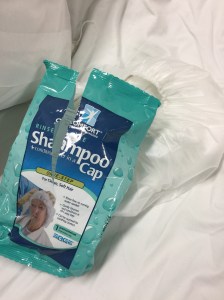
It’s an actual room, not just a curtained corner, so I do have privacy, which is nice. When it’s determined that I’ll need to be admitted, and there’s not a room available, the nurse has a hospital bed brought in, so I can get off the thin mattress that reminds me of the fold-out mat I used in kindergarten at naptime. It is a thoughtful thing to do and I am grateful. Any comfort–like the nothing short of a miracle shampoo shower cap–in this storm feels like a life preserver.

There is a lot going on out there.

Someone (as I make my way to the bathroom later I see a policeman in the hall) yells for a man to get back in his room. Apparently he doesn’t realize that being under arrest means you can’t just go tooling around the ER willy-nilly.

Several medical professionals come and go from my room. I am asked the same questions by different individuals. I think my answers are pretty consistent: Been feeling a bit poorly for a week or so but not alarmed until this morning; no I haven’t been out of the country; no I didn’t notice a tick or a rash on my body; yes I get yearly physicals; no I haven’t seen blood in my urine; no I don’t smoke.

One man, let’s call him Doctor X (not his real name) shall we, pulls a chair close to the bed and gets even closer to my face.

“Ms. Wilson.” Pause. “What do you think is wrong with you?”

His tone makes me feel like a kid, when my mother would ask me, “What do you think you did wrong, sweetheart?” (For the record, she did not have to ask me this often as I was an exemplary child. Or so the story goes.)

“I have no idea,” I say, when what I am thinking is more along the lines of, “If I knew, I promise I’d tell you. If I had a nagging suspicion, a mere inkling, any semblance of intuition, a scrap of insight, I’d share it with you.”

He makes me feel as if I am holding something back, as if I don’t want them to know everything they need to know in order to figure out what is happening with my body.

“What about HIV? A lot of times these low white cell counts indicate HIV.”

“I don’t think so,” I said.

“You’re not at high risk, you don’t think?”

“No sir.”

“Multiple sex partners? Drug use?”

“No sir.”

I don’t have the strength for regaling him with all the reasons I don’t think I’m a candidate for HIV, and I feel so bad I start to think maybe I’ll be some fluke case of contracting it. It could happen, I guess. I don’t have an issue with the testing; test away. I have an issue with the delivery. Why not something like, “It’s standard for us to test for HIV when we see such low white counts.” More equalization; less shame.

“Okay, well. You need to know that this could be serious.”

Again, maybe you could try: “We don’t know what’s wrong with you but we’ll do everything we can to find out. It could be an infection, or it could be something more serious.”

So, um, Doc, I’m already convincing myself I might be dying. I’m in the ER, so I get it, that this might be serious. To me it already is. I’m way ahead of you.

Doctor X leaves and comes back so fast I’m surprised he had time to turn around.

“I’m testing you for HIV.”

“Okay,” I say. “Fine. Of course.”
An Otherwise Ordinary Day {Every patient has a story.}

The next several posts will be about my recent hospital stay for what has been deemed “an acute infection of unknown origin.” I’m writing about my experience in order to process what happened—and is happening—to me.                                                                                    

img_6605
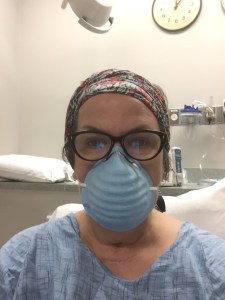
I would swear I had a neck when I came in here.

After several days of feeling “not quite right” I wake up and know something is terribly wrong.

“We have to go,” I croak to Precious. So we drag my exhausted self to a walk-in clinic, whereupon I am promptly instructed to go to the emergency room.

“You have neutropenia,” says the doctor. “Something we often see in cancer patients. You’re not a cancer patient, correct?”

“Correct.”

“You have a fever of 101 and your white blood counts are low. You need to get to the ER, now.”

I start to cry, that’s how bad I feel, how frightened I am becoming.

Precious drives me to Vanderbilt and I resist the urge to Google scary diseases on the way. Thankfully I don’t have the energy for it.

I have long been a person who says she “wants to know, even if it’s bad,” but right then I am not so sure.

The nurse at the ER put a mask on me, and repeatedly expresses her surprise when I tell her, repeatedly, that I am not undergoing treatment for cancer.

“No,” I say. “I’ve never had a cancer diagnosis.”

I am convincing myself, of course, that I’m about to get one.

On Driving Dicey Mountain Roads, Learning to Write, and Making New Friends

IMG_5716Long an admirer of The Sun magazine, which I think publishes the best writing around, I was delighted when the opportunity came up for me to attend the magazine’s writing retreat at Wildacres Retreat Center in western North Carolina. (Meaning I hadn’t signed up in time but was notified when someone cancelled and I was first up on the waiting list.) Wildacres hosts some fabulous sounding workshops for all sorts of creative types, and I plan to return. It’s lovely, Wildacres, set apart–far, far, apart–from all things distracting, among verdant greenery and rustling wildlife. Peaceful, natural, and away from cell towers. And the food is good…

Getting there was tricky, what with downed road signs, dense fog, and my innate ability to “get turned around,” but every tricky curve up the mountain was worth it. After the last turn off anything resembling a well-traveled road, and fearing I was hopelessly lost and possibly in some trouble–the fog was really that hard to see through and I didn’t have cell reception–I stopped at the only commercial entity I’d seen for miles.

“I think I’m lost,” I said as I opened the door to the charming Books and Beans, which is just like the bookstore I dream of opening one day: cozy, full of books of all varieties, comfy chairs by the fireplace, strong coffee, set in the mountains. There may have even been a dog by the hearth, it was that perfect.

“We’re all lost up here,” said the woman behind the counter, smiling. Thankfully I was just two miles from my destination. A vanilla latte and two books later I was on my way.

As usual at these kinds of gatherings—I go to a lot of writing workshops; they’re like vacation for me—I’m nervous at the beginning, wondering if I “fit,” and then, within a couple of hours, I am settled and confident and in my element, surrounded by kindred spirits who care about words with the same intensity that I do. Which means they’re sort of obsessed.

I was familiar with only one writer scheduled to present, Leslie Pietrzyk, as I had read, and enjoyed, her Pears on a Willow Tree (Harper Perennial). Two writers new to me–though perhaps I have read their work in The Sun and simply misplaced their names, something I do more and more these days, misplace things of import–are already favorites.

When Joe Wilkins read from his The Mountain and The Fathers (Counterpoint) I looked around the room to see if everyone else was hearing what I was hearing: well-crafted sentences of such feeling and awareness that I moved to the edge of my seat just to draw a little closer. I subsequently bought every book he had for sale that weekend.

Another writer I’m glad to know about is Chris Bursk, a poet who was funny and heartfelt and one of the best workshop leaders I’ve ever had the pleasure to experience. He was generous, engaging, and knowledgeable, willing to share whatever he knew that might help the rest of us write better poems. And he handed out kazoos, so bonus points for that.

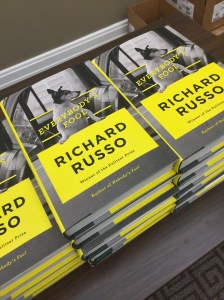
IMG_5850Upon returning to Nashville my husband and I went to hear Richard Russo at our fabulous library. He was in town promoting his new book, Everybody’s Fool (Knopf), which I look forward to reading. Russo was just as I had imagined he would be in real life: engaging, approachable, considerate, and smart. When asked what informed his writing, he responded, “I write about the things I notice twice.”

I love that so much. We all notice things once, but what draws us back for another look? Maybe even a third or a fourth circling round. That’s where the gold is, right?

Not only did I learn something about writing at both these events, but I also met interesting people, like the man who told me to check out St. Paul and the Broken Bones after I told him I had enjoyed hearing the Alabama Shakes in Asheville recently. (Seriously, people, run to listen to them if you haven’t already. Brittany Howard belted it out like I’ve never witnessed before. Stunning.) My new friend was spot on with his suggestion, for St. Paul now sits at the top of my current playlist.

And the woman who lives in New York, whose writing is searing and moving and tender, which I learned only after returning home and going online as she was too humble to tell me she’d been in literary journals many of us dream about publishing our work.

IMG_5736I applied for a job at The Sun a while back and although I made the first cut, being invited to critique issues of the magazine, I was not called for an interview. I’m glad I didn’t let any disappointment keep me from attending this retreat. For there is always something to learn about the practice of writing, a bit of inspiration to glean, a recommendation to take to heart, a fellow pilgrim to meet.
What informs your writing? What do you look at twice and want to know more about? In other words, what haunts you so much that you’re driven to write it out?

Amy Lyles Wilson

A Eulogy for My Mother

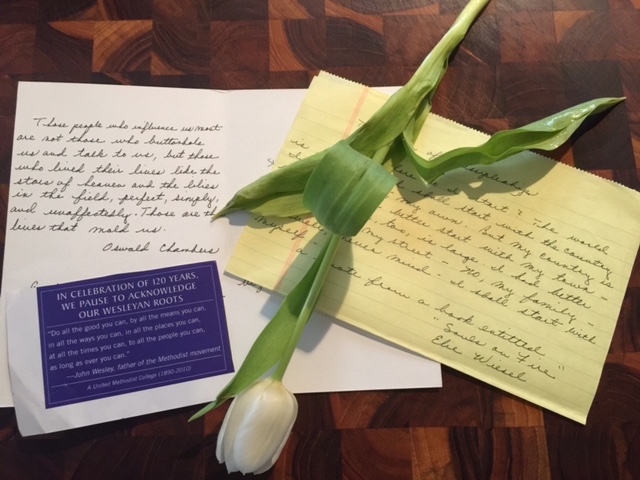
ALW-Mother-Eulogy-BlogInstead of regaling people with charming anecdotes about my childhood (dancing to “I’m a Little Teapot” in the living room) or relaying repetitive accolades (“Your mother was one of the most influential people in my life.”) about how precious my mother was—and she was dear—when giving her eulogy on February 23, I instead read three passages I dug out of one of my “memory boxes” while crying and packing my suitcase for Mississippi after my sister Ann phoned to say, “This is the call you never want to get.” Bits and pieces from a long life well lived that illustrate, better than a hundred family snapshots, what made Martha Lee Lyles Wilson (1922-2016) such a remarkable woman.

One was a quote she included in a birthday card she sent me; another was a passage she wrote on a sheet of yellow legal-pad paper; and the third was a quote she cut out from a magazine. In short, these snippets reveal how my mother made her way in the world, and how she inspired those around her to follow her lead as best we are able:

“Those people who influence us most are not those who buttonhole us and talk to us, but those who lived their lives like the stars of heaven and the lilies in the field, perfect, simply, and unaffectedly. Those are the lives that mold us.”—Oswald Chambers

“Do all the good you can, by all the means you can, in all the ways you can, in all the places you can, at all the times you can, to all the people you can, as long as ever you can.”—John Wesley

“But where do I start? The world is so vast; I shall start with the country I know best, my own. But my country is very large; I better start with my town—but my town, too, is large. I had better start with my street. No, my family. Oh well, never mind. I shall start with myself.”—Elie Wiesel

I don’t know if the quotes she clung to are punctuated or even worded exactly as they appeared in print, and to me it doesn’t matter. The philosophies are clear, and they now have a permanent place in my heart, right alongside my mother.

Rest in peace, good and faithful servant.

Obituary for Martha Lee Lyles Wilson


Call Me When You Get There

Before I married, at age forty-one (yes for the first time), I had just about had it up to here with friends patting me on the shoulder and saying, “You’ll just know.” They were trying to make me feel better by telling me I would know when the right person came along. They were assuming that the right person would show up, even though my father taught me early on that there are no guarantees in life. I never dreamed of a knight on a horse, or even a banker in a Buick. So my friends thought they were making me feel better when I didn’t even feel bad to start with. I did, however, often feel worse after they fussed over my singlehood all the while regaling me with stories of their idyllic couplings and pictures of their perfect children.

It didn’t seem like the end of the world to me that I might live my whole life without marriage. I suspected it would be more fun with a partner, and there were Friday nights when I felt desperately sorry for myself, but I did not consider pairing up a prerequisite for a fulfilling and happy life.

“Why haven’t you married?” people would ask me. This seemed to me a preposterous question, one that answered itself. I hadn’t married because the right opportunity had not presented itself. The crush from high school didn’t ask, and I didn’t trust—or love—the one who proposed in my twenties. Plus, I think he was drunk at the time.

“Maybe you’re expecting too much,” friends would say, when all I really expected of myself was not to marry for the wrong reasons.

“What are you looking for?” they would surely inquire, and this one I had an answer for: Someone who cares whether I get home safe and sound. Someone besides my parents. I had often joked that the man who said these words to me, preferably while holding me close or leaning in to kiss me, would be the one: “Call me when you get home so I know you’re okay.”

So when, a few days after our first date, as I was preparing to leave my hometown where I was visiting and return to Nashville, where I live, Precious tapped on the driver’s side window as he stood in the parking lot of the coffee shop where he’d bought me a “sweet roll” for breakfast and said, “Please call me the minute you get to Nashville so I won’t worry about you,” I just knew.